Showing posts with label What I'm Drinking. Show all posts

Tuesday, January 3, 2012

Burgundy Rules!

Once again I was happy to be included at an impromptu dinner with JVE and friends, held on short notice due to a visit from afar of one of our esteemed members. JVE suggested Burgundy as the theme, putting up a bottle of DRC La Tache 1993 as incentive - needless to say there were not many no shows! In any case the crew dug deep and we tasted a great assortment of top notch wines that led to the dinner concluding with a call for a trip to Burgundy ASAP - I'm in!! Thanks to all for their generosity and camaraderie and especially to JVE for hosting yet another superb evening! Here are my rough notes, quickly taken and only slightly edited:
Paul Pernot 2007 Batard Montrachet - lovely! just opening and showing some complex tones of acacia, linden and apple. Softer and plusher than expected. Lovely core of solid fruit. Still young and primary but delicious! A few bottles available at 56 Degree wine.
Lamy Pillot 1993 Le Montrachet - Wow! Lush and complex and beautiful. Mouth filling, super-long. This was great out of the gate and just got better and better as it opened - improved significantly throughout the evening. Full, lush yet with great detail and underlying acidity. Acacia, linden, nutty caramel tones with good solid fruit. Outstanding wine!
Aubert Ritchie 09. Black spice. Ripe. New world saturated. Hint of petrol. Sweet. Alchy. Spiced black cherry liqueur. Some vanilla notes. Very saturated and dense. This opened nicely with an hour or so in the glass. Drink now, better in year or two and over 3-4 years thereafter.
Williams Seylem 04 Farrington vineyard. Earth. Mint. Some maturity. Touch rustic even. More mature. Leather and dried fruits. At its peak. Might have guessed it Burgundy if tasted blind. Starkly different from Aubert.
Volnay 2007 Cuvee Blondeau Simon Bize. Hospice de Beaune. Wow. Beautiful elegant red cherry, supple, Very detailed and fine. Drinking beautifully, will improve for 3-4 at least. Silky and pure, sexy Volnay on the lithesome side. Lovely wine.
Corton Bressandes 2005 Vincent Girardin. tight. touch reductive. Closed. Mineral notes, firm. Well proportioned and solid. Tight deep solid core of red cherry fruit. Opened and relaxed with some time in the glass. Great future ahead, 5 -10+ years. vg++

Vosne Romanee 1995 Latour dried leathery, a bit past prime.
Gevrey Chambertin 2004 Claude Dugat - Fresh turned earth. (merde was uttered, with some questioning the exact type) With time deeper cherry dark fruit emerged. Still earthy, a hint of green. Needs more time, 3-5 years minimum, to shed its youthful, compact attributes and whiff of 2004 greenness and for at least that long after.
Trapet Chambertin 2008 - Coolish. Tight. A touch greenish and herbal, with darker tones underneath. Med ruby. good. Young. Still closed and angular and young. Needs time! Drink in 10-15 years. Very Good+, just a bit young and tight right now.
Charmes Chambertin 1996 Perrot Minot. Med deep ruby/purple. A bit angular and high toned at first, closed a bit on the nose and palate, highish acids. Meaty leathery, dark cherry tones - seemed a bit awkward at first, opened with time. Very good+, but needs 4-5 years more at least.
Chambertin Clos de Beze Groffier 2002. Beautiful crushed cherry, spice. Still fresh and youthful but just out of its shell. Supple, harmonious. Balanced long, complex and intriguing. Silky. Beautiful. still young and somewhat primary, lovely mouth feel, ripe tannins, long, lingering persistent finish. Great wine! As good as it is tonight is still a baby, love to revisit this in 10+ years!

La Tache DRC 1993. Dark cool spiced. Intense. Porcini mushroom, black cherry, tight, structured and firm. Dark concentrated with tart black cherry fruit core. Wound tightly and while focused and firm not showing its stuff tonight. Highish acidity, went back to it after being opened for a bit not much change. This should have been rockin' and just couldn't figure it out tonight.

I looked this up when I got home as it was so perplexing, Burghound reports the following:
"Tasting note: (As noted in Issue 4, I have experienced a fair amount of bottle variation with the '93 but both this bottle and a second bottle that I had in early May were outstanding). ("severe, closed and understated but I am convinced it will be a great La Tâche" - AdV). This too evidences a slight floral quality, and a fascinating mix of earth, leather, tea and spice notes plus an interesting green bark component. The slightly austere, tannic, wonderfully rich flavors are dense, in fact extremely dense with excellent depth and terrific complexity and a finish that seems to go on forever. Though there are now hints of secondary aromas, this remains very young, structured and remarkably intense. When you get the right bottle, the '93 can be a real stunner. Note: the inconsistency of this wine continues unabated as a bottle opened at the Domaine recently was almost aggressively vegetal and awkward. In short, when it's good it's very good but I've now had too many disappointing bottles not to be wary." Not encouraging for a wine that trade well over the $1,000 mark!!
Clair Dau Clos de Beze 1962. another "WOW!" Hazy and a hint of brick. Nose mature yet vibrant and still fresh. Incredible! Earth. Sous bois, marmite. Magnificent from first whiff to last, lovely, lingering sip, with a finish lasted til the Jersey side of the Tunnel!
Thanks again JVE and everyone for a great night!

Monday, December 5, 2011

Once more to Mecca - A night at Brooklyn Fare

Part two of the weeks outstanding dining agenda took place at Brooklyn Fare with Chef César Ramirez and his truly amazing, indescribable, mind-blowing cuisine. I wish I could recall it all myself, but with the help of good friend Mark Scudiery and some of the rest of the
clan that was there that night, a decent accounting of the menu exists. (Mark's excellent Blog "Wine Without Numbers recounts the evening well better than my notes - click here to read). They really don't like you taking notes at Brooklyn Fare, and you will be reminded if you stray - but I respect that, and so I put away camera and iPhone after about course 4 and surrendered to the show. Ceasar wants you to be present in the moment, not head down in your device, tweeting bragging rights to your blog buddies. But it is SOOOO good, and there is so much variety, nuance, finesse....so much going on that it is nearly impossible to recall without a little crib sheet. All I can say is that every taste he plates up in front of your eyes is hors category, and every time way more than a few are far beyond that.

And then you have Cesare himself, focused, intense and subdued early on, warming up and relating a bit more as the night goes on. I can well imagine that the tone of the crowd on a particular night plays a role. Every time I am there it's a little like a winery visit where it can start a little cool as they sort of feel you out, sense your interest and passion, and once gauged, the whole mood warms (or not as the case may be). Meanwhile a non-stop, choreographed production goes on - no wonder he's quiet at first, he has a lot to do! We are talking 15-20 dishes prepared in Cesars own words "like your are working with no net, nothing to hide - everything up front, one shot at it, right in front of your eyes". It really is food theater at the very highest level. No pressure!

Why do I love his cooking so much? Why is this simply the best restaurant I have be
en to (twice now) since El Cellar de Can Roca? It's the amazingly creative, simple, perfect composition of every taste I encounter here. It is first and foremost about the ingredients: ingredients, ingredients! (David Bouley espoused the same just a few nights before. Nothing but great, fresh, seasonal, impeccable food. Second is the technique - only those with the very best can be so deft and subtle, and yet complex at the same time, interpreting, expressing - never taking over. Each part in its place, each flavor carefully chosen - nothing more, nothing less -
resulting in compelling,thought provoking flavors and textures. It's precise, measured - almost contrary to the high tech approach - this is simply perfect food, perfectly prepared and presented.

Oh, I almost forgot - did I mention we had seven wines from Domaine Leflaive? Yes, THE Domaine Leflaive! Hard to believe that wines of this caliber were almost an afterthought - but in retrospect it was because they too were in perfect harmony, melding with the cuisine, heightening, complimenting, and contrasting with the wonderfully nuanced food - the mineral, crisp 2007s were perfect with the seafood dominant menu. Many perfect pairings, building from Macon Verze, Bourgogne Blanc, Puligny Village, several 1er Cru Wines and on to the Grand Crus, and finally one lonely but delicious Maillard 1993 Aloxe Corton Corton 1er Cru les Lollieres. An excellent night - as Mark says in his blog "Hail César!"

Monday, August 8, 2011

Cassis - A Mediterranean Gem

The region of Cassis, on the sparking Mediterranean coast on the south of France, is perhaps one of the most beautiful wine regions on earth. It is a popular tourist and vacation spot (about 20 kilometers east of Marseilles), with dramatic views of the sea, the mountainous cliffs (some of the highest maritime bluffs in Europe), and the beautiful rocky coves called Calanques.

It is also known for its delicious, if little known white and rose wines, and supposedly even tinier amount of red which I have never seen. The cliffs along the coast have been maritime landmarks for centuries, and this region has been occupied since the Ligures arrived in 500-600 BC, with the Romans not far behind. Cassis is also known for its stone, its quarries producing masonry for the quays of Alexandria, Algiers, Pireaus and Marseilles, as well as for the base of the statue of Liberty.

It is a tiny wine region, with only 12 Domaines making wine from 196 hectares of grapes. In some ways its beautiful location works against grape growing due to high land values that threaten the vineyards with development, and the stunningly beautiful cliffs and rocky outcrops that offer no room for expansion. There have been efforts to enforce strict zoning to protect existing vineyards however, and it seems that for now the tiny production of the region is safe. Soils are mainly limestone, with about 75% of the production white wine and the balance rose. Grapes for white include Clairette, Marsanne, Ugni Blanc, and Sauvignon Blanc.

At 56 Degree Wine we carry two producers: Domaine du Bagnol and Clos St Magdeleine, when we can get them that is! Not much wine is produced, and with local demand high, not much of that is exported. I look forward every year to the wines' arrivals, both the whites and especially the rose wines, whose arrival seems to herald the arrival of summer. The whites are crisp, clean, unoaked, but good body and character - perfect seafood companions! The Rose wines are dry, clean and aromatic, with slight variations from producer to producer and vintage to vintage, but are always among my favorites we stock. They are perfect with all sorts of appetizers, cured meats, grilled veggies, tapenades, salads of all kinds especially classic nicoise with seared tuna, and grilled fish like snapper or Bronzino.  There is nothing quite so great as taking a small boat along the coast, packing a picnique lunch, a few chilled bottles of Cassis Blanc and Rose, and finding one of the secluded coves with a pebbly sandy beach and spending a lazy afternoon. Another gem is La Villa Madie located at the foot of the cliff just next to Clos St. Magedeleine. To see a list of Cassis wines in stock, Click here.

2008 Clos Ste Magdeleine Cassis Blanc - ORGANIC / BIODYNAMIC - This is one of the most beautiful locations for a winery in the world, bar none! Perched on a bluff above the sparkling blue Mediterranean, they craft lovely Cassis Blanc and Rose from grapes grown in their own estate vineyards. The region is miniscule, only producing something like 40,000 cases in total, and would probably have disappeared altogether if it weren't for strict zonong that restricts further building.
Region: Cassis (Provence), France
Grapes: Marsanne, Ugni Blanc, Clairette and Bourboulenc
Farming: Certified Organic & Biodynamic
Drink: Now
Cuisine: appetizers, grilled veggies, cured meats, olives, tapenade, grilled fish or a salad nicoise.
ABV: 12.5%

2010 Clos Ste Magdeleine Cassis Rose - ORGANIC / BIODYNAMIC - the ultimate summer party wine! - This lovely, classic dry rose is from vineyards around the village of Cassis, literally a stones throw from the sparkling Mediteranean Sea.  It is made from 70% Grenache, 15% Cinsault & 15% Mourvedre, all local red grape varieties with the juice and skins pressed and macerated together for just enough time for the wine to pick up its lovely salmon color.  Gathering hints of red fruits and its tinge of structure before the skins are removed, its then fermented dry much like a white wine. Great served chilled with grilled seafood or poultry, all kinds of salads (nicoise - perfect!) seared rare tuna and all on its own on a warm night. Liquid summer!
Region: Cassis (Provence), France
Grapes: 70% Grenache, 15% Cinsault & 15% Mourvedre
Farming: Certified Organic & Biodynamic
Drink: Now
Cuisine: Light appetizers, poultry, seafood, salads
ABV: 12.5%

2009 Domaine du Bagnol Cassis Blanc - Comprised of 50% Marsanne, 35% Clairette and 15% Ugni Blanc, Domaine du Bagnol has fashioned a wine that is the epitome of fresh white from Provence.  The thing that separates them from the pack is the layers of flavors that unfold in the glass, making this stimulating wine on many levels.  Melons, white peach, honeydew with pears making an appearance as the wine resolves in a long finish.  Lovely cleansing acidity, a wealthy of juicy fruit and nice texture make this a perfect choice for seafood, shellfish, roasted chicken or as a great aperitif.  Ready to enjoy now so no need to wait.
Region: Cassis (Provence), France
Grapes: 50% Marsanne, 35% Clairette & 15% Ugni Blanc
Drink: Now - 2012
Cuisine: Seafood of all sorts -  seared or sushi style scallops, tuna, swordfish, rouget, fresh sardines, or as an aperitif with anti-pasti, olives, cheeses, saucissons, crusty bread.
ABV: 13%
Price: $27


Thursday, August 4, 2011

A Night on the Town in Phily - Lec Bec Fin

Dinner with JB and a couple of friends and clients in Philly, with the night starting at a spectacular location high in the Liberty 2 Tower, replete with cloud to ground lightning from a squall line raging through downtown viewed from our perch just above Billy Penn's chapeau, and the full expanse of the Delaware to the 30th Street station as a backdrop. 

We started off with a 2000 Zind Humbrecht Heimbourg Riesling - Medium gold, nose of beeswax, petrol, lime blossom, and wet stones. On the palate baked apple, more lime and citrus, evolved and perfect and fresh, with firm minerality and more stony texture. From the ZH web site: "The Heimbourg of Turckheim is a small vineyard sloping 35% to the west, facing the east side of the Brand, then turning abruptly towards the south with the slope increasing to over 50%. Climatically, this hillside enjoys a lengthy period of evening sunshine, because thanks to its position facing the Munster valley, the vines are not in the shade created by the Vosges mountains. The west side is a late-ripening area, the grapes ripen slowly, always retain good acidity and develop noble rot late. The south side is naturally a lot warmer and early-ripening (the same goes for the Clos Jebsal), but always benefits from the wind from the valley which prevents the noble rot from developing too early.

The soil structure is a clay-limestone substratum (oligocene limestone and interbedded marl) where the yellow or white calcareous rocks are present in large numbers on the surface. We have chosen to plant the Pinot Gris in the upper part which faces west and has the poorest and stoniest soil. The Gewurztraminer lies just below, also facing west. The small south side was planted with Riesling in 1994. The wines produced on the Heimbourg are rich, opulent, often very spicy and affected with noble rot. The slower ripening of the grapes often produces more aromatic wines when young that its neighbor the Clos Jebsal."

After sopping up the last drops of the ZH in the posh environs of TK's apartment, we headed to Le Bec Fin for dinner. We started with a first Course of Pike Quenelles, Sauce American. Light, perfect, deceivingly rich yet delicate at the same time. With a lovely sauce served over fava beans all dramatically presented and assembled a table. This with a fantastic 2004 Puligny Montrachet Clos Mouchere Domaine Jean Boillot that started out great and only got better and better with a little time in the glass. In 4-6 years this lively, crisp but layered 2004 should be fantastic, and pretty good tonight!

Roasted Sweetbreads and Warm Shrimp, Sweet Potato, Burnt Orange Vinaigrette, Madeira Jus - Jean Boillot Volnay 2002 Chevret 1er Cru - JB had had a bottle or two previously that were off (oxidized) and so we were a bit worried, but this one was perfect: fresh, lovely dark cherry, beautiful fruit, still primary but having softened and just about to show some secondary tones (but not just yet), just beautiful, succulent, and pure, broadening and opening in the glass with time. The second wine was, of all things, a Janasse Chateauneuf du Pape 2009 Chaupoin - 100% grenache, ripe and saturated for sure but with floral fresh fruit tones amid all the power, and good acidity and fresh fruit tones underneath. Grape variety : 100% Grenache - stems removal : 80 % - maceration : 22 days , must pressing : once a day - elevage : 30 % barrels (1/4 new), 70 % vat - rendering : 25 - 30 Hl/ha - plantation : 1912 for the oldest part - keep time : 5 to 25 years. 2/3 in Foudre, 1/3 in 600 liter Demi-Muids. While the Burgundy worked best overall, seamlessly integrating with the sweetbreads, the sauce was pretty intense and the dish actually sort of held up to the Chateauneuf du Pape. 

Kombu Cured Wagyu Beef, Tasting of Potatoes, Labne au Poivre , Sauce Bordelaise - Mouton Rothschild 1988 - a wine I have had on a few occasions but not in the last 3-4 years. Every time I have had it it was still quite tight, reflecting its coolish "classic" Bordeaux vintage, with a tannin structure I worried would ever resolve and lose its almost greenish notes. Well it has finally come around, still fresh, with cedar and #2 pencil tones, earth, lovely structure, and the cool, balanced focus of a wine newly emerged from its shell. Beautiful!

Dessert Cart - Cheesecake, light and creamy and perfect, chocolate double dark gateau, rich yet not heavy, a fresh fruit tart, and a double espresso for the road. As much as I would have loved to, I passed on the invitation for cigars back at the ranch and headed east to stay at my sister in laws to avoid the slog back to North Jersey. Thanks lads for a great night!

Wednesday, August 3, 2011

Chaine Event at Matts Red Rooster

Great dinner with the Chaine at Matts Red Rooster in Flemington, with Summer Grillin' and Chillin' the theme. We had Chef/Owner Matt McPherson create a menu inspired by summers fresh, seasonal ingredients and worked the wines back from there to match. It was a great evening - superb food, great service, enthusiastic and appreciative crowd and the wines worked out ok too!! Thanks to everyone at Matts for a great job and to Celia for putting it all together! I really like this restaurant, the preps, the fresh local slant, the open kitchen and the BYO! Glad to be back for such a great event and have made promises to myself to come back more often! The menu and wines:


Reception - Chilled, Truffled Griggstown Chicken Liver Pate, Watermelon & Fresh Mozzarella Skewers w/ pickled red onions, Grilled Flat Bread w/ charred apricot chutney & roasted foie gras , Heirloom Tomato Gazpacho Shooters, A.B.C. (Avocado, bacon & crabmeat)


2009 Ameztoi Txakolina de Getaria - Who knew that a white made partially from a red grape could make a wine that is so devoid of color, yet so bathed in flavor intensity. Hondarribi Zuri (white grape) and Hondarribi Beltza (red grape) are grown on sandy, limestone soils in the heart of the Basque country near San Sebastian. Vinified in stainless steel tanks and bottled with a touch of natural residual carbon, this lively, zippy white has just a little spritz to it. I liken it to the most amazing grown-up limeade you'll ever encounter with the joy of effervescence. When at an authentic bar like Txikito, they will serve this wine to you in a tumbler, just as they do in San Sebastian. A special pourer is inserted in the top of the bottle and the wine is poured from high up to release all that frothy goodness in the glass. And while this certainly is a refreshing quaff, its also serious and complex wine delivering a multitude of flavors: fresh lime, sea salt, minerals, hint of mint

Region: Getaria, Spain
Grapes: Hondarribi Zuri (white grape) and Hondarribi Beltza (red grape)
Vini/Viti: Stainless steel cool fermentation
Cuisine: Light fish, seafood, apetizers of all types
Drink - Now
SRP: $22


First Course - Grilled Day Boat Scallop, Roasted local beet & horseradish compote

2008 Domaine Bzikot Bourgogne Blanc - From a great plot along the Puligny bench, Sylvain Bzikot tenderly cares for his vines in Huilleres. They lie right alongside those of Domaine Leflaive and the
vinification is just as exacting and meticulous as his village and 1er cru sites. He gently presses the wine and vinifies 1/3 of it in barrels (5% new) with the remainder only treated to stainless steel. This lends
texture but not oakiness. Clean and fresh on the palate, the Bourgogne shows Puligny-like characters of
apples, pears and stony mineral notes in the long finish. Superb now, but I suspect this little wine will live on and strut its stuff with flash for another four years.

Region: Burgundy, France
Grape: Chardonnay
Drink: Now - 2014
ABV:
SRP : $28

Second course: Wood Fired Romaine Heart, Roasted Corn & Creamy Parmesan Dressing

2010 Mas de Cadenet Sainte Victoire Cotes de Provence Rose - In what is clearly the steal of the season,
this wine from the small appellation of Sainte Victoire is destined to be the stuff of legend. And rightfully
so... It's that outstanding. Usually, Provence Rose is light and crisp, the ultimate refresher on a hot day.
Although Sainte Victoire is not on the tip of most wine lovers proverbial tongue, it is very well known in
Provence for making Rose wines with grace. This is the most complex Rose I've had all year. Floral and
pretty aromatics of jasmine and strawberry lead the way to a palate filled with light cherry, watermelon,
white peach, sea salt and a very long and mineral finish. Possessing a lovely salmon color and lively
acidity, this is phenomenal wine to enjoy right now.

Region: Sainte Victoire, Provence, France
Grapes: 40% Grenache, 40% Cinsault & 20% Syrah
Vinification: Stainless steel tank (no oak)
Farming: Sustainable
Drink: Now - 2012
Cuisine: Seared Tuna, Shrimp, Soft Shell Crab, Grilled Chicken
ABV: 13%
SRP : $18


Entrée - Sous Vide New York Strip Steak, Finished on the wood fired grill, paired with cold smoked heirloom tomato, demi- glace and served with Summer Vegetable Skewers and Grilled sweet potatoes


2009 Domaine de la Janasse Cotes du Rhone "Cuvee Tradition" - A kirschy lovable Cotes du Rhone,
Domaine de la Janasse keeps the focus on ripeness of fruit and not on the wood. While this is certainly not a rustic CdR, it has magnificent fruit purity and outstanding length. Choosing to only put 60% of the wine in oak, and of that only 1/3 of the barrels new, they made the wise decision to use cement vats for the rest of vinification. A juicy, racy wine based on Grenache, but also containing Syrah, Carignan, Cinsault and Mourvedre, the Cotes du Rhone Tradition lavishes the palate bing cherries, raspberries, jam and spices. A delicious wine and excellent Cellar Defender to enjoy now through 2015.

Region: Cotes-du-Rhone (S. Rhone,) France
Grapes: 55% Grenache, 25% Syrah, 10% Carignan, 5% Mourvedre & 5% Cinsault
Terroir: Red clay & crushed pebbly soil located to the north of Courthézon
Vinification: 60% French Oak (1/3 new) & 40% cement vats
Drink: Now - 2015
Cuisine: Grilled Steaks, Burgers, Roast Pork
ABV: 14.5%
SRP: $18.50

2007 Domaine Laffont Madiran "Cuvee Erigone" - This tiny Domaine (3.9 hecatres) produces one of the top wines from this little known region tucked into the Pyranees in the southwest of France. The Erigone (the name of the goddess seducced by Dionysus) is made from 80% Tannat and 20% Cabernet Franc grown in limestone and gravel soils. Vines are an average of 45 years old. They are detemmed, descending into wooden tanks by gravity, and undergoe a cold maceration for several days, then fermented with all natural yeasts and a veru long (5 weeks) maceration. Yhe wines then go into barrel, 2 and 3 year old, for 16 months. The wines go through malo in the barrels, and they are bottled with no fining or filtration. The results are big, sturdy wines with ample structure and the rugged framework they absorb from the region they are grown. SOlid, firm and chewy, with ripe tannins and well integrated oak. perfect for steaks, lamb, and game such as boar or venison. Drink now - 2016+

Region: Madiran, France
Cepage: 80% Tannat, 20% Cabernet Franc
Vinification: Wood casks, then 2-3 yr barrels for 16 months
Cuisine: Hearty fare - beef, lamb, game, stews, braised meats
Drink: 2011 - 2020
SRP : $18.50


Dessert: Peaches & Cream Bread Pudding


Cerdon de Bugey, Renardat-Fâche - This wine comes from a little known wine region with more obscure grape varieties. The small French town of Cerdon lies in the shadow of the Alps, and it is here that Alain Renardat-Fache makes his unique Cerdon de Bugey. This is a pink sparkler made from Gamay and Poulsard grapes using the traditional method of aging the wine in the bottle and disgorging like Champagne, but it's a lot less money! It has moderate sweetness, but is not cloying or heavy at all - just like eating fresh berries - naturally low alcohol makes it a perfect choice on a warm summer day as an aperitif, or after dinner for a refreshing nip that won't do too much damage!
Region: Rhone, France
Grapes: Gamay, Poulsard
Drink: Now
Cuisine: Apertif or Desserts with berries or chocolate
ABV: 7.5%
SRP: $24

Mylestone Equine Event

A summer evening in the country for a great cause! Mylestone Equine Rescue exists to provide a home for horses who, having served there "useful" life, are headed to their demise. Mylestone provides a much better retirement plan - an organization I am more than happy to support! The evening was great - weather summery and warm, but cooler and drier than the week long humid heat wave we suffered. They served up lots of passed apps, followed by a buffet of barbecued chicken, cole slaw, salads, and other sides, followed by great desserts. 


The wines:


Gorleri Vermentino
Mahoney Vermentino
Lamblin Bourgogne Blanc
Relativity Chardonnay
Voillot Bourgogne Rouge
Sinskey PN Aries
Janasse CdR
Lioco Indica Red


Summer Fare

Wines of the day: Bzikot Bourgogne Blanc ($28) and Chinon Rose 2010 Gasnier ($15) - liquid summer! Paired with sashimi ahi, sliced medium thin and served with soy and wasabi, to start. Then on to Jersey corn, simply steamed and rolled in butter, heirloom tomato with sea salt and pepper - both so sweet they don't need anything else, steamed haricots vert with olive oil, sea salt and a squeeze of lemon, roasted farm fresh zucchini, onion, yellow peppers and and an unbelievable wild sock-eye salmon (also from Metro) roasted to medium-rare with thin lemon slices. 


Bzikot Bourgogne Blanc ($28) - A terrific value and spoiler wine for those who say all good Burgundy is expensive. Balanced, mineral stony Puligny-esque qualities make this a wine that drinks WAY beyond its meager Bourgogne Blanc status. But what else would you expect from this up and coming superstar? Drink now - 2015.


Chinon Rose 2010 Gasnier $15 - All Cabernet Franc from the heart of the Loire Valley. Light salmon, fresh, crisp, light and delicious! Perfect summer rose for a starter, or with grilled Tuna, slamon, all kinds of apps, salad nicoise. Dry, delicate, perfumed with hints of raspberry and strawberry. Grab it while its here, its as fleeting as summer itself!


Wednesday, July 20, 2011

To Italy and the Alps

Today the Tour begins its alpine swing traveling from Gap in the Hautes Alpes to Pinerolo on the Italian side with a few category 2 & 3 climbs and a category 1 over the Sestrieres at 2035 meters. Over the next several days the Tour will be decided in the Alps, with Alberto Contador flexing some muscle and giving the Schleck brothers, Claudel Evans and the other GC contenders something to worry about before a time trial in Grenoble and the final day in Paris on the Champs Elysee on Sunday.

The route runs a little south of the Alpine growing areas of the Savoie and Jura, but close enough to include a perfect tour sipper Cerdon de Bougey. Located in the foothills of the Alps about halfway between Lyon and Geneva, the vineyards are a patchwork of parcels facing southeast or southwest, interspersed with fields, pastures, grazing cattle and patches of forest. The wines of Bugey were produced as VDQS since 1958 and received full Appellation status in 2009.

Father and son team Alain and Elie Renardat-Fachet employ a technique called "ancestral method" for this incredible pink sparkler. Harvest is by hand, then the grapes are pressed and fermented in cold vats until the alcohol reaches about 6 degrees. The wine is lightly filtered with most of the active yeast left in the unfinished wine, it is then bottled and ferments in the bottle to about 7.5 or 8 degrees of alcohol, and a good amount of its original sugar. Fresh, fruity and sparkling, loaded with raspberry and strawberry notes, it is sweet but not cloying so. Perfect aperitif or after dinner, its natural low alcohol means you can have another glass on a warm summer day!


Cerdon de Bugey, Renardat-Fache - Click to purchase at 56 Degree Wine


Region: Bugey, France
Grapes: Gamay, Poulsard
Drink: Now and within first year of release
Cuisine: Apertif or Desserts with berries or chocolate

Wednesday, July 13, 2011

Tour de France - Le Sudouest de France

On Tuesday and Wednesday Stages 10 and 11 take a relatively gentle route with just a few small category 3 and 4 climbs as the riders travel through the heart of southwest France before the first real test in the mountains on Thursday, Friday and Saturday. The  route passes near Marcillac on Tuesday and includes a sprint through the village of Gaillac on Wednesday - villages that are home to two of my favorite country French red wines. Well off the beaten track and definately off the radar of most wine drinkers, I absolutely love the wines from this region for their unabashed individualistic character. Located along the river Tarn (a tributary of the Garonne, the river that eventually winds its way through the Graves and Sauternes and combines with the Dordogne at the Gironde estuary in Bordeaux), they are both some of the oldest wine regions in France. 

Marcillac is located about an hour drive north and east of Gaillac along the Tarn River. It is made mainly from Mansois, the local name for Fers Servadou, and the grape accounts for about 90% of all plantings. My favorites here are Domaine Laurens, whose red and lovely crisp rose we have stocked, and Domaine du Cros, a beautiful, juicy if slightly rustic red with crushed red fruits and hints of game and earth. This small grower had only one hectare in 1982 and made a mere 4,000 bottles per year. Today they have expanded by buying and renting vineyards with 22 hectares in production out of a total of 25ha.  

Gaillac claims to be the oldest wine region in France, with origins dating to the first century and records of Romans shipping wine down the Tarn to Bordeaux and northern Europe. The white wines are made from Mauzac, Sauvignon Blanc, Loin de L'Oeil, Muscadet and Ondenc, and are crisp, light and refreshing with floral notes. The reds are made from  local grapes Duras and Fers Servadou, but can also have Syrah, Cabernet Sauvignon and Cabernet Franc. Domaine Sarrabella is a producer seeking out both for their delicious, floral and fresh white and their deliciously rustic red.

The reds from both of these regions are the perfect "Bistro Wines" in my opinion - mid weight, slightly old world and earthy, with moderate grip and sour cherry fruit tones. They are perfect with light meat - pork, roasted chicken, duck breast "magret de canard" or classic steak and frites. Tomorrow and over the next three days the Tour heads to the mountains of the Pyrenees and some of the toughest climbs in the world - don't miss it!


Friday, July 8, 2011

Tour de France - Through the Loire!

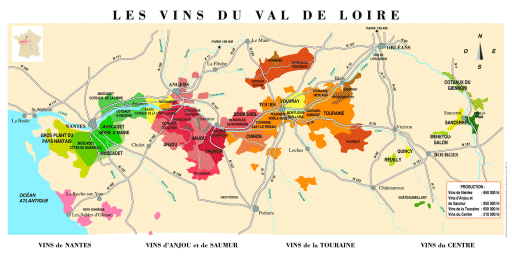
Today the Tour winds its way down from Normandy and the coast and passes very near the heart of the Loire Valley. This noble river winds its way over a thousand kilometers from its beginnings in the Ardeche at about 4430 feet near Mont Gerbier de Jonc. It flows to the north and then makes a hard turn towards the west near Orleans and finally to the Bay of Biscay at Saint Nazaire. It spans such a wide range of climates and soils that the types of grapes grown vary as you travel along its course, and the wine style also vary dramatically response to local conditions or "terroir". It is really best to think of the Loire as four major regions, the eastern Loire, followed as you head downstream to the west by the Touraine, Anjou-Saumur, and the Region Ouest, each of which is comprised of multiple small AOC's.

Along the route it passes though some of my favorite wine regions, the first and easternmost of the better known wine regions are Sancerre and Pouilly Fume. These are located are well inland, just north of Nevers and are known for crisp, racy, mineral Sauvignon Blanc and a tiny amount of red and rose from Pinot Noir that can be quite enjoyable, all grown in the semi continental climate and flinty limestone soils of the Kimmeridgean belt. Reuilly,  Menetou Salon and Quincy are nearby and offer similar wines at at lower price than the more famous Sancerre and Pouilly Fume.

Just after it passes these famous villages, the Loire bends to the west, sweeping in an arc through Orleans and into the Touraine. Inexpensive Sauvignon from the Touraine can be found here, good summery and inexpensive. But the best known wines are the superb dry and sweet white wines made from the Chenin Blanc grape grown on chalky soils in vineyards surrounding the villages of Vouvray and Mont Louis, and terrific reds from Cabernet Franc in Chinon, Bourgueil, and Saint Nicolas de Bourgueil.  Olga Raffualt is one of my favorite reds, delicious and fresh when young and able age for years in the best vintages.

Anjou - Saumur is next, with Cabernet Franc from Saumur Champigny and Saumur the top reds, and a dozen small AOC's making dry and/or sweet styles of Chenin that are among the best in  the world with Quarts de Chaume, Coteaux de Layon, Savennieres and Bonnezueax among the tops.

Finally in the east is Muscadet, just to the north and east of the start of this years Tour in the Vendee. Its crisp, racy high acid whites perfect with the seafood and shellfish of this region by the sea.

So grab a glass of wine from the Loire, turn on the Versus network and drink in the beautiful scenery of this spectacular region of France. For a list of wines from the Loire available at 56 Degree Wine - click here and type "Loire" in the search box. See the list below for a couple of favorites. For a truly in depth explaination of the Loire, visit the Wine Doctor website - Cheers!

Claude Lafonde Reuilly 2009

2008 Domaine Damien Lorieux Bourgueil Cucee Graviers

Gasnier Chinon Rose 2010

2009 Domaine Huet Vouvray Clos du Bourg Sec

2009 Domaine de la Potine Sauvignon Blanc Touraine

2009 Domaine Serge Laporte Sancerre Chavignol


Tuesday, June 28, 2011

Domaine Terrebrune

Domaine Terrebrun is located near the village of Ollioules in the region of Bandol (Provence) in the sunny, beautiful south of France, not far from the sparkling Mediterranean. The estate had mainly olive trees when it was purchased by Georges Delille, a Paris trained Sommelier. On the advice of Lucien Peyraud, owner of the famed Domaine Tempier who told Georges that there was "gold under the ground at Terrebrune", he began the hard work of clearing, building terraces, and planting vines in the brownish clay and pebbly limestone soils over blue limestone subsoils. The vineyards are mainly south facing on gently terraced slopes, influenced by the winds that funnel in off the sea. The combination of the soils, climate and Reynauds philosophy of natural, organic practices create uniquely expressive wines of beautiful detail and a freshness underpinned by lovely minerality.Today the estate has 30 hectares of vines producing white, red and rose wines.

The estate is certified organic, with no herbicides, pesticides or chemical fertilizers. The soils are worked by plow and hand hoe, and vines are tended and harvested by hand, with selection happening in the vineyard rather than at sorting tables. Grapes are de-stemmed, gently pressed and fermented only with indigenous yeasts in cool, underground cellars in gravity fed cuves, and are bottled unfiltered and unfined. 

The reds is a blend of 85% Mourvedre, the lynch pin of the reds of this regions, with 10% Grenache and 5% Cinsault. Deep and dark, it nevertheless has a fine structure and elegant balance of firm structure and dark, earthy fruit that varies slightly from vintage to vintage. The 1997 is just passed its more vibrant youthful phase and showing hints of leather and dried fruits of beneficial bottle age.

The white is a blend of Clairette, Ugni Blanc and Bourboulenc, and is fresh and crisp, with white flowers, a good middle core and hints of yellow fruits. 

The Rose, perennially one of my favorites, is fresh, perfumed, and mineral with lovely acidity in 2010. It is versatile and food friendly - perfect for summer dining. Salad nicoise with grilled rare tuna, salumi, olive tapenade, grilled vegetables, ratatouille and grilled fish of all types come to mind as the perfect partners. I can't get enough! And as good as this wine is in its youth, it ages amazingly (something I never really think of with rose) and I have had some very old vintages, with the wine taking on a creamy, complex richness that I am not sure where I would place if I had it blindfolded. AT a recent visit, after tasting through several vintages of the reds, Reynaud disappeared into the deepest part of the cellar and came back with a bottle of the 1994 Rose - lemon creme, supple and viscous on the palate, still quite fresh - a unique and delicious experience! 

And if the outstanding quality of the wine were not enough, there is an excellent restaurant on site called Le Table du Vigneron, where we had a fantastic lunch along with a wide assortment of wines and vintages from the Domaine. Reynaud is a quite, thoughtful person and his nature is reflected in his approach to the estate and its wines. These are not "blockbuster" wines, they are pensive, balanced and exquisitely crafted expressions of the land and region where they are grown. Reynaud has been here with us as well for a wine dinner and I hope he'll come back again! To purchase the wines visit us at 56 Degree Wine online.

Some images from our visit and excellent lunch:


Thursday, March 10, 2011

Tips for BYO's - Some Thoughts on Making the Best of a BYO Restaurant

The ability to drink what you like is one of the best advantages of going to a BYO. You can always have your old fav and not pay restaurant prices! I know people who love big Cali Cabernets with everything from sushi to steak, and while I wouldn't do it, who am I to judge? I say have at it! Personally I like much more variety and diversity and make an effort to anticipate the flavors, weight and elements of the food at each restaurant. The ability to choose wines to match from my cellar or favorite wine shop is another BYO advantage. The beauty of BYO is that while many licensed restaurants carry "safe" wines - popular brands and grape varieties they know will sell - BYO gives me the freedom to explore and push the boundaries with a wide range of lesser known grapes and regions and way more opportunity to match the food - again without paying wine list mark-ups!

When trying to decide what wine to bring, first do a little research on the restaurant. If it's Italian, chances are that Italian wine is your best option, if it's a French Bistro, bring some country French wines, if seafood is the specialty you may bring a few extra whites, and hedge with a few extra reds if it's a steak house. Asian or or ethnic specialty restaurants will also factor in to wine choices. Best to call and ask about specials or go online and look at the menu and then plan the wine.

Always bring a little more than you need. "Corked" or "off" bottles can leave you high and dry, or an irresistible menu special might lead your wine pairing down a different path than you had initially planned for. Don't mind the stares, we always bring an overstuffed wine bag - if we don't use it all we just take'em home!

Bring a range of styles that are versatile and will cover a big range of foods. A nice light crisp white is a great way to start. Muscadet, Sancerre, Pouilly Fume from the Loire Valley of France, Vernaccia di Sangimignano, Arnies or Verdicchio from Italy, Albarino or Godello from Spain, and Gruner Veltliner from Austria are great food friendly options that will cover a number of salad, seafood and light appetizers. A fuller style of white to cover lobster, scallops and richer seafood dishes, as well as some poultry and other mid-weight dishes is a must. California Chardonnay of all sorts work for those who like more fruit, oak and power, white Burgundy for those who like a little more restraint, elegance. For reds, a medium bodied wine such as Pinot Noir or Rioja will cover medium weight cuisine such as pork, veal, duck. For fuller meat dishes such as short ribs, steaks and lamb, break out the full throttle reds. Bordeaux varietals (Cabernet Sauvignon, Cabernet Franc, Merlot, and Malbec) from all over the world work great here, as will wines made from Rhone varietals such as Syrah, Grenache and Mourvedre. These are the safe versions, but don't forget there is a wide world of wine out there! BYO's give you the opportunity to bring a bunch of wines to try. Again, if you open one and it doesn't work out just cork it up, take it home and have it tomorrow. Push the envelop and explore!

Glassware and service: Even some licensed restaurants have sub-standard stemware, and while I have seen many BYOs improving wine service, there are still a few who don't get it. It's geeky, but there is nothing wrong with bringing your own if the house version isn't up to snuff. If you bring an old and rare wine be sure to pay attention to service. It can vary in any restaurant, BYO or not, but at unlicensed locations there is typically less wine training. Difficult corks and sediments found in older wines can case problems for untrained servers so it is often best to take over opening and decanting in this case, or at least (nicely!) oversee the operation. Decanters at BYO's often don't get much use, so even though they may have been put on the shelf clean, over time they will gather fine dust or aromas that can ruin a wine. Be sure to have any decanter rinsed and cleaned prior to pouring the fine old bottle you have been saving.

Tuesday, January 25, 2011

Dreaming of Wine in America - Repost!


This post originally ran back in March of 2009 but as we are just getting in in the new vintage of the El Llano, the 2009 Carneros Chardonnay and doing a dinner with Rolando Herrera I thought it was worth a revisit! Wines have been updated to reflect current price and availability at the time of the post. Cheers!

Wine Dinner Information:
Mi Sueno at the Pluckemin Inn


Mi Sueno, which means “my dream” in Spanish, is the realization of the dream and vision of Rolando Herrera. In what is a great American story, Rolando was born in a small village in Mexico, and looking for a better life, moved to California in 1975. His life in the wine trade began humbly enough as a dishwasher at Auberge du Soliel, then on to line Cook at Mustards’ Grill where he began to appreciate the magic of great food and wine. At the age of 17 he took a summer job working as a laborer building a stone wall for Warren Winiarski of Stag’s Leap Wine Cellars, and was then offered a job working the harvest with the provision that he attend school in the afternoons. It was the beginning of a career that included 10 years at Stag’s Leap (the last seven as Cellar Master), assistant wine maker at Chateau Potelle, Winemaker at Vine Cliff and Director of Winemaking at Paul Hobbs. At each step along the way he absorbed his experiences, learning different aspects of winemaking, grape growing and marketing, developing his own vision which evolved into Mi Sueno.

“Each stop played a significant role in refining my style of winemaking. Stag’s Leap was the foundation.  It was here that I learned to appreciate the smell of the grape must and the feeling of being surrounded by barrels of fermenting wine. In addition, Warren taught me the value of attention to detail as well as to respect and enjoy the product we were making. At Chateau Potelle I was introduced to French winemaking techniques, including all-natural fermentation. I also learned that while anyone can make wine, to craft a truly unique and special wine, winemaking becomes more of an art form. My tenure at Vine Cliff provided me, for the first time in my career, a chance to be in complete control of the final product.” 

Eventually Rolando’s brother Ricardo joined him, having spent 10 years developing his talents as Cellar Master at Dominus and Assistant Winemaker at Screaming Eagle. Today they have a vineyard management company, and farm 40 acres of their own vines as well with terrific vineyard sites in Napa, Carneros and the Russian River Valley.

The wines are sold to us by Juan Prieto, owner of Vinifrance Imports, and Juan’s story is just as good as the Herrera’s. His family, solid middle class Cubans, lost everything when Castro and the communists came to power, nationalized private property and took their family business. After many hardships, they were finally able to leave Cuba and made their way to America with little more than the clothes they left with. Through hard work and drive, Juan and his family got him through school with a degree in Psychology which today is where he mainly makes his living. But his love of wine and food drew him to the wine business, and he began to travel, ask questions and learn everything he could. Eventually this led him to winemaker Michael Havens, a great long time friend of mine and Napa Winemaker, who subsequently led him to me about 20 or so years ago to ask advice about getting into the wine business. After giving Juan as many reasons as I could think of for not leaving his bread and butter job to open a wine distribution company, he went ahead and did it anyway. Today he has a great portfolio of artisan growers whose style and approach to winemaking we heartily endorse, making wines we love for their purity, expression, and natural approach, and of course, for their sheer brilliant quality. But he still has his day job!


We both work with on the French supply side with importer Olivier Daubresse, who aside from introducing us to some of our favorite French producers (Pascal Maillard, Guillon, Grivot and many more) has by far the most precise palate I have ever tasted with. With what I would call total recall and utter sensitivity, he is able to discern subtle changes that often the winemakers themselves don’t pick up in their wines. Travelling with Olivier is part and parcel to what I love about this business. I have spent long days the cold cellars in France together working on blends and selecting wines to import where you can see the relationship of respect and open communication between Olivier and his growers (Olivier pulls no punches!). This trust and understanding is based on a pursuit of excellence and results in our ability to source truly great wines (and share them with our clients!). Long, grueling days in cold cellars (I know, tough job!) are rewarded with lingering lunches and dinners, often with the winemakers digging deep in their cellars for magnificent wines in a spirit of sharing, mostly tasted blind, that challenges your senses and truly makes you think about what you are tasting. Vintage, soils, grapes, terroir, winemaking; how did these flavors and nuances arrive at the place and time we are drinking them? Every great wine tells a story of the year and conditions they were grown, the grapes and the soils and climate of the vineyards where they were grown, and the winemaking and care of the winemaker. 

Olivier’s personal story begins in the north of France, in a region best known for industry and far from wine country. As he tells it, the French social structure is a somewhat stratified system where upward mobility is difficult in terms of education, employment and career advancement, with layers of tradition and bureaucracy often creating impediments. So like many, Olivier went into the service industry, in his case the wine trade as a Sommelier, where he worked his way up to Wine Director of one of the best restaurants in France. He, like Rolando, found that his spirit was yearning for a better life in a place where his entrepreneurial ambition could be more easily realized, and eventually made his way to America. With stints at Bouley and Daniel in New York, he eventually left to follow his own dream of creating a business to import the small family owned estates he loved. These stories remind me, in a time when there seems to be so much negativity and doubt, of what a great place our country really is, with possibilities that exist here and nowhere else in the world. 

So what does all this have to do with wine? Not much, really, but it does reflect a little on my approach to it in a business sense. While the quality absolutely has to be there, wine is about more than just what's in the bottle, and definitely more than reading the press, checking the scores and ratings and stocking what is popular. It's about choosing to work with people who believe in what they do, who have a passion so strong they are willing to take risks and walk a sometimes difficult path to accomplish their goals. When you surround yourself with people with these characteristics and philosophy, quality usually follows - but on to the wines!

What I love about these wines is that they are a summation of all the experience and talent from the Herrera's years learning their art, and yet they sell for a fraction of the price of the wines from the places where they learned it. In addition, while they have California exuberance, they are also restrained and elegant, balanced, plush and deliciously drinkable. All are extremely limited production and worth getting to know. 

Mi Sueno Chardonnay Carneros 2009 – The grapes for this wine are grown in the cool Carneros region, and the resulting wine is balanced, with good ripeness and lively tropical fruit, creamy vanilla and a clean finish. About 35-40% new oak keeps it in check and allows the delicious fruit to shine through. Incredible value! $32/bottle

Mi Sueno Chardonnay “Sonoma Mountain” 2007 - The Sonoma Mountain is full, rich, but with restraint and only moderate oak, hints of apple, nutmeg and vanilla. Tiny production – excellent quality! $49/bottle

Mi Sueno Carneros Pinot Noir 2009 - This wine was first made by Mi Sueno in 2002 with purchased fruit, but discontinued it until their own vineyards were mature enough to provide the fruit. Planted on white soils with lots of lime it has lovely aromatic of red and dark cherry, lively fresh and mouth filling on the palate - California fruit (but in check), with fresh acidity underneath and a silky, smooth middle and finish. Lovely! Tiny production. $39/bottle

Mi Sueno El Llano 2009 - This is a blend of between 20-35% Syrah with the balance Cabernet Sauvignon, depending on the vintage, from vineyards near Caldwell's in the Coombsville area of Napa. Deep and dark, with cedar components and focused dark fruits both on the nose and palate. Long, solid and balanced, with just enough oak to compliment but not dominate. $49/bottle


Mi Sueno Napa Cabernet Sauvignon 2008 - Although the 2007 vintage was highly regarded for its vigor, depth and cellar-worthy characteristics; 2008 did not fall too far from the same tree!  Three words for you: elgance with decadence. This wine was crafted in the classicly-balanced style that Rolando has been known to make. Showcasing fruit from the Coombsville area of Napa (soon to be an AVA), this Cabernet is sure to grab your palate's attention with its firm, yet approachable tannins followed by its smooth finish. Tiny production, only 5 cases available. $65/bottle